Exploring the Power of 'Materials Create a Better World' — BAID Students Visit the Artificial Crystal Research Institute
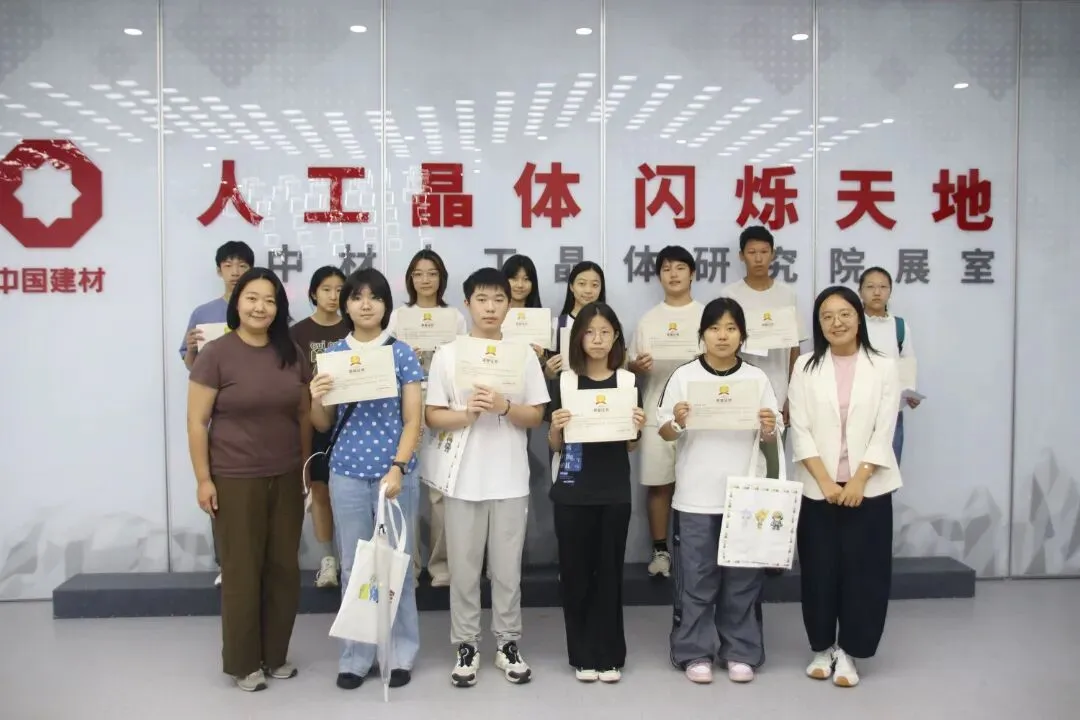
On August 26, 2026, BAID students were invited to visit Sinoma Synthetic Crystals Institute Co., Ltd. for a science outreach program themed Integration and Symbiosis, where they explored the science and technology behind synthetic crystal materials.
The program combined interactive experiments with a tour of the exhibition hall and expert lectures. The first activity, an ice cutting experiment, immediately captured students' attention. By conducting the experiment themselves, students gained an intuitive understanding of thermal conductivity.
The experiment compared three materials with very different thermal conductivities: a quartz wafer and graphene, followed by synthetic diamond. Heat from the human body, at around 37°C, was transferred through these highly conductive materials to the ice, melting a narrow path and allowing the material to cut through it.
The differences were immediately visible. Quartz had much lower thermal conductivity than the other materials, so cutting required considerable pressure and took much longer. Graphene, with a thermal conductivity of about 1,500 to 1,800 W/(m·K), felt almost as thin and light as paper, yet sliced through the ice with only gentle pressure. Synthetic diamond performed even more dramatically. With thermal conductivity reaching approximately 2,200 W/(m·K), it moved through the ice with almost no resistance. Students described the experience as "like cutting tofu."
Exploring the Exhibition Hall
During the exhibition tour, students examined laser crystals and infrared window materials, along with glass ceramics, scintillation crystals, piezoelectric crystals, and diamond materials. They also learned about major milestones in the institute's history, including the work of Academician Shen Dezhong's team in solving significant technical challenges in crystal research.
The exhibition also featured large synthetic quartz crystals and synthetic diamonds, giving students an opportunity to compare natural crystals with their laboratory grown counterparts.
Three Expert Lectures
01 Xie Huikai: The Internet of Everything and MEMS Technology
"Gyroscopes and accelerometers inside smartphones all depend on MEMS devices."
Starting with familiar smartphone technology, Xie Huikai introduced the basic principles and wide ranging applications of MEMS, or microelectromechanical systems. He also discussed emerging areas such as AI chip cooling and brain computer interfaces, both of which create new technical demands for crystal materials.
He encouraged students to build a strong foundation in mathematics and the sciences during high school, remain curious, and develop the habit of asking questions rather than simply receiving information.
02 Liu Xuechao: The Space Furnace and Crystal Growth
Liu Xuechao introduced the high temperature materials experiment facility aboard China's space station, sometimes nicknamed the "space furnace." With just 500 watts of power, the device can reach temperatures of 1,600°C while keeping its outer casing at only 39°C.
The system took seven to eight years to develop, can manage 16 samples at once, and has operated reliably in orbit for more than 1,300 days. Liu also introduced the current T shaped three module configuration of the Chinese space station. He noted that an expansion module is planned for launch in 2028 and that China also plans to develop a lunar research station in stages.
03 Sun Jun: From Mineral Gemstones to Optoelectronic Crystal Materials
Sun Jun began with major gemstones including diamonds and sapphires, then discussed rubies, emeralds, and cat's eye gemstones. From there, he introduced the rapid development of synthetic crystal technologies.
"The current price of rough lab grown diamonds has fallen to around RMB 800 per carat," he explained. He also noted that synthetic crystal research is one area in which China has developed internationally competitive capabilities.
He closed with a broader reflection: "One of the defining differences between humans and other animals is our ability to accumulate and pass knowledge from one generation to the next. Compared with nature, humanity still has an enormous amount to learn."
The half day visit passed quickly, yet it gave BAID students direct contact with advanced materials and current scientific research. The long history of synthetic crystal research, the technologies introduced during the three lectures, and the materials students handled during the ice cutting experiment offered a vivid introduction to materials science and encouraged further curiosity about scientific research.
Student Reflections
Liu Shuyao:
I felt very fortunate to participate in the institute's seventh Resource Stewardship Day open event. After a brief opening session, we began an extraordinary exploration of materials science.
The first experiment left the strongest impression on me. We tried cutting ice with quartz, graphene, and diamond. The quartz barely seemed to cut at first. When we moved on to graphene, the difference became immediately obvious. Graphene felt extremely soft in my hand, yet once it touched the ice, it could cut through surprisingly easily. We only had to place it gently on the surface. Pressing down too hard actually made the process more difficult, which even reminded me of non Newtonian fluids.
At first, I assumed that a soft material cutting through solid ice must depend on some complicated scientific principle. Then I realized that the explanation came from something we had already learned: heat conduction. These materials conduct heat extremely well, so heat from our hands travels rapidly through them and reaches the ice, melting the contact area.
That made me realize how close science is to everyday life. Phenomena that appear almost magical can sometimes be explained by principles we already know.
We then toured the institute's exhibition hall. It contained an extraordinary range of synthetic crystals and documented more than six decades of crystal research in China. I was amazed by the variety of exhibits. We were also able to touch many of the samples, each with a different texture. Materials I had previously encountered only in textbooks or online were suddenly right in front of me.
The final two hours featured expert lectures on MEMS technology and the space furnace, followed by a session on mineral gemstones. The title The Space Furnace immediately caught my attention. During the lecture, Liu Xuechao even connected the technology with Sun Wukong's fiery eyes from Journey to the West. Ideas that once belonged to ancient mythology are gradually finding echoes in modern science.
Liu also mentioned that he had spent more time working with the space furnace than with his own child. That comment stayed with me because it revealed how much of his life he had devoted to research and China's space program. His dedication to scientific work and to the country deserves our respect.
I also found the discussion about diamonds fascinating. During the Q&A, I asked a question that had interested me for a long time: do cultural differences between China and Western countries lead to different ideas of beauty?
Sun Jun gave me a clear answer. Many Chinese people value natural jade because every piece is created by nature and cannot be reproduced exactly. In many Western countries, diamonds have traditionally held greater appeal, even though many diamonds today can be produced artificially.
That discussion helped me see that a crystal can carry scientific significance while also reflecting the culture and traditions of different societies.
The morning passed quickly. I came away understanding that every brilliant crystal represents countless hours of research by scientists and engineers. The same is true of major inventions and scientific achievements. They never appear from nowhere. The imagination found in ancient myths may plant the first seeds, while science gradually gives some of those ideas a place in reality.
As young people, we should preserve our curiosity, observe carefully, and keep thinking. I hope to continue learning and exploring science, and perhaps one day contribute in my own way to China's materials research.
Ding Fanxiu:
How can a tiny electronic component provide a precise time reference for complex equipment? How can microscopic material structures support technologies used in lasers and aerospace engineering?
With these questions in mind, I visited Sinoma Synthetic Crystals Institute this morning. It was my first opportunity to learn systematically about crystal oscillators and MEMS.
Before the visit, these terms felt distant and abstract. I had occasionally encountered them in science articles, yet I knew very little about how they worked. This experience showed me that technologies based on the piezoelectric effect and mechanical vibration ultimately grow from fundamental scientific principles.
I had once assumed that timing in electronic devices depended entirely on chips. I had overlooked the importance of a stable time reference. During the visit, I learned that quartz crystal oscillators, which vibrate through the piezoelectric effect, function as the clocks inside many electronic systems. I also learned that the institute, founded in 1963 and now part of China National Building Material Group, is associated with the development of China's first quartz crystal.
Learning about MEMS expanded my perspective further. Modern manufacturing can miniaturize mechanical structures and integrate them with electronic circuits to create microscopic resonant devices. Quartz crystals offer exceptional precision. MEMS devices offer compact size and greater resistance to vibration. Each fits different engineering contexts.
During the Q&A, I asked an expert about where the two technologies are most appropriate, and received a detailed explanation. The exhibition also demonstrated how synthetic crystals can exhibit optical and electrical properties, alongside thermal, mechanical, and magnetic characteristics. Their applications in communications, aerospace, and many major national engineering projects gave me a much more concrete sense of the importance of crystal materials.
As the visit continued, I realized that crystal technologies and MEMS cannot be placed in a simple hierarchy. Material properties and manufacturing processes determine performance, and engineers choose technologies according to the demands of each application.
Technological development also allows older and newer approaches to coexist. MEMS has become common in consumer electronics because of its compactness and durability, while quartz crystals continue to play an important role in high precision communications. Each technology serves areas where its particular strengths are needed.
Over more than six decades, the institute has received multiple national science and technology awards while continuing its research into critical foundational materials. Its commitment to both technological innovation and science outreach left a strong impression on me.
As Dr. Sun Jun said, "One of the differences between humans and animals is that humans learn." This visit showed me just how much knowledge lies behind foundational materials. I am grateful to the institute and its speakers for giving us an opportunity to explore current developments in materials science.
The experience expanded my understanding and encouraged me to remain curious in my future studies. I hope to keep asking questions and exploring the scientific world.
Wang Siyuan:
I visited the synthetic crystals institute in Dongba for a science outreach program and had the opportunity to see the innovation behind China's crystal materials research at close range. In the exhibition hall, we learned about different categories of crystals and explored several of the institute's major research achievements. The three expert lectures expanded my understanding even further.
The first speaker introduced MEMS technology. These devices are already embedded in many everyday products, enabling functions such as motion sensing and automatic screen rotation on smartphones, with many more applications still being developed.
The second speaker introduced a crystal growth facility aboard China's space station, often called the "space furnace." Its design allows it to reach 1,600°C using only 500 watts of power, while the exterior remains at around 30°C. I found that astonishing. He also explained that the microgravity environment of space can support the growth of high quality crystals that are difficult to produce on Earth.
The third speaker introduced different types of crystals and methods for synthetic production. Today, many gemstone crystals can already be manufactured artificially, bringing significant changes to the gemstone industry.
Before this visit, crystal science had always seemed distant from everyday life. I now understand that tiny crystals support major technologies in fields such as aerospace and electronics. I also developed great respect for the researchers in China who continue working through difficult technical problems and expanding the boundaries of what these materials can do.
This visit introduced me to an entirely new microscopic world. In the future, I hope to build a stronger foundation in what I learn at school while remaining curious and observant. I want to keep exploring science and hope that one day I can contribute to China's scientific and technological development.
This AI translation is provided for reference only. Please verify with original Chinese version.